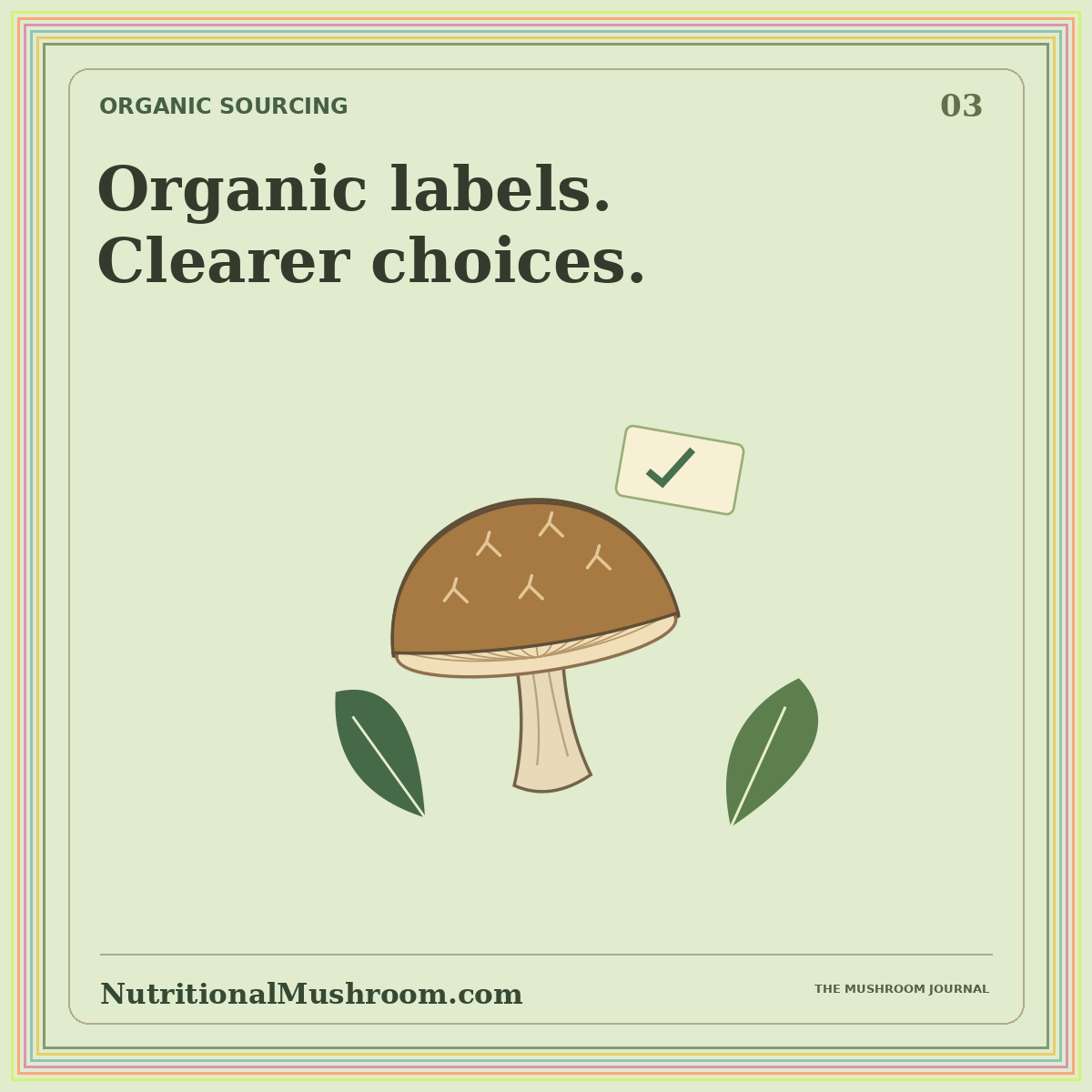
An organic label can help answer a production question, but it does not answer every shopping question. It does not tell you whether a mushroom will suit tonight's recipe, how much is in the package, or whether an extract will deliver a promised health effect. Understanding the scope of the claim is the first step toward a useful purchase.
This guide focuses on United States organic labeling. Other countries have their own standards and labeling arrangements, so do not apply the percentages here to every product sold internationally. The practical aim is to read the exact claim, understand which product it covers, and know what to ask when the packaging is unclear.
Read the claim before the design
A green package, a leaf drawing, and a rustic photograph are visual choices. They are not the same as an organic certification statement. Start with the words on the label rather than the overall impression. Is the finished product labeled organic, or does the ingredient list identify just one ingredient as organic? Those are materially different statements.
This distinction matters across the mushroom aisle. A tray of fresh mushrooms is different from a soup mix, a coffee blend, or a capsule containing several ingredients. Before comparing two items, decide whether you are comparing a single food, a multi-ingredient food, or a supplement. Similar mushroom artwork does not make the products equivalent.
Know the main U.S. categories
USDA describes several organic labeling categories. “100 percent organic” refers to all-organic ingredients, excluding salt and water. “Organic” generally requires at least 95 percent organic ingredients, excluding salt and water, with restrictions on the remainder. A qualifying product in these categories may carry the USDA organic seal.
The “made with organic” category requires at least 70 percent organic ingredients, excluding salt and water, and has additional wording and ingredient restrictions. It does not allow the USDA organic seal. Products below that threshold may identify particular organic ingredients in the ingredient statement without presenting the finished product as organic. The USDA source below provides the details and exceptions.
Why percentages are not a nutrition score
These percentages describe organic ingredient content under the labeling framework. They do not measure protein, vitamin content, extract concentration, freshness, or clinical effectiveness. A larger organic percentage is not a larger dose of a nutrient. Treating the label as a nutrition ranking mixes two different kinds of information.
For a practical comparison, keep separate columns in your notes: organic claim, ingredient list, package amount, intended use, and price. This makes it possible to value organic sourcing without asking the label to do work it was never designed to do. You can then decide which factors matter most for your particular purchase.
Fresh mushrooms: check the actual product
At a store, confirm that the organic label refers to the mushrooms you are choosing rather than a nearby shelf sign for another item. Compare the label on the package with the shelf description. If the mushrooms are loose, ask the retailer which lot the sign covers and how the claim is documented.
At a market, ask the grower a neutral, specific question: “Is this crop certified organic, and who is the certifier?” Listen to the answer rather than replacing it with assumptions about the size or location of the farm. A nearby producer is not automatically organic, and an organic product is not automatically local. Those can be separate purchasing preferences.
Understand that exemptions exist
Avoid assuming that every legitimate organic claim follows an identical certification pathway. USDA identifies limited exemptions, including an exemption for certain small producers with less than $5,000 in annual organic sales. Such operators still have relevant requirements and cannot use the USDA organic seal for those uncertified products. The source explains the conditions.
For a shopper, the sensible response is a respectful question, not an accusation. Ask what supports the claim and whether the product is certified or sold under an exemption. A seller should be able to explain the basis of the description. If the answer remains unclear, you can simply choose another product or wait until you have enough information.
Powders and blends need an ingredient-level look
A mushroom powder might contain one ingredient, several mushroom ingredients, or additional flavorings and carriers. Read the full ingredient statement before deciding what the organic wording means. A blend can display an organic ingredient claim without every component having the same status, depending on its labeling category and applicable rules.
Imagine two hypothetical products: a single-ingredient culinary mushroom powder and a sweetened drink mix containing mushroom powder. Even if both make an organic claim, they are not direct substitutes in a recipe. Compare their intended use and complete composition. The organic question should be one part of that comparison, not the only part.
Organic does not establish supplement effectiveness
For supplements, certification and evidence answer different questions. An organic claim concerns production and handling within a standard. It does not establish that an ingredient improves memory, treats illness, or is suitable for a particular person. A quality-related claim and a health-related claim should be evaluated separately rather than combined into one impression of credibility.
Use our supplement label guide when the product is a capsule, extract, or concentrated preparation. For differences between forms, read mushroom powder versus extract. Neither guide treats organic status as a guarantee of personal safety or a replacement for professional advice.
Ask better questions about home growing
A home-growing kit may describe its ingredients, its production process, or a certification held by its supplier. Read exactly what the claim covers. Does it refer to the growing block, a component, the operation, or the finished product? Do not assume that every future harvest carries an unrestricted certification claim simply because one input was labeled organic.
For personal use, you can keep the purchase label and follow the supplied instructions without trying to become a certification expert. If you plan to sell mushrooms or make an organic claim in commerce, speak with an appropriate certifier about the specific activity. A consumer article cannot establish your business's compliance obligations.
Compare value without inventing a premium
Use actual local prices when considering cost. There is no universal organic premium that applies to every species, package, shop, and season. Compare similar quantities and forms, and account for whether you can use the full purchase. A modest pack suited to two planned meals may be more practical than a larger purchase with a lower unit price.
You can also decide that certified organic sourcing is important for some purchases but not a requirement for every meal. This is a personal shopping preference, not a verdict about the worth of other foods. Food budgets and availability differ. The goal is a clear decision grounded in the information actually available.
A repeatable label-reading routine
First identify the product: fresh food, culinary powder, blend, or supplement. Then read the exact organic wording and look for the certifier information where applicable. Next examine all ingredients and the package amount. Finally, consider your intended use and whether the seller's explanation resolves any uncertainty.
Keep a photograph of a label when you want to compare it later, but avoid relying indefinitely on an old image. Products and packaging can change. Check the item you are actually buying. This habit is especially useful when an online listing shows several versions of a package or when a retailer substitutes a similar product.
The takeaway
An organic label is most helpful when you understand both its meaning and its limits. Read the wording, identify what it covers, and separate production standards from nutrition and health claims. Visit our organic mushroom hub for a shorter shopping checklist, then choose the product that fits your recipe, priorities, and budget.
Source and further reading
The U.S. labeling categories and exemption summary above are based on USDA Agricultural Marketing Service guidance on labeling organic products. Consult the official guidance or an accredited certifier for a specific labeling decision.