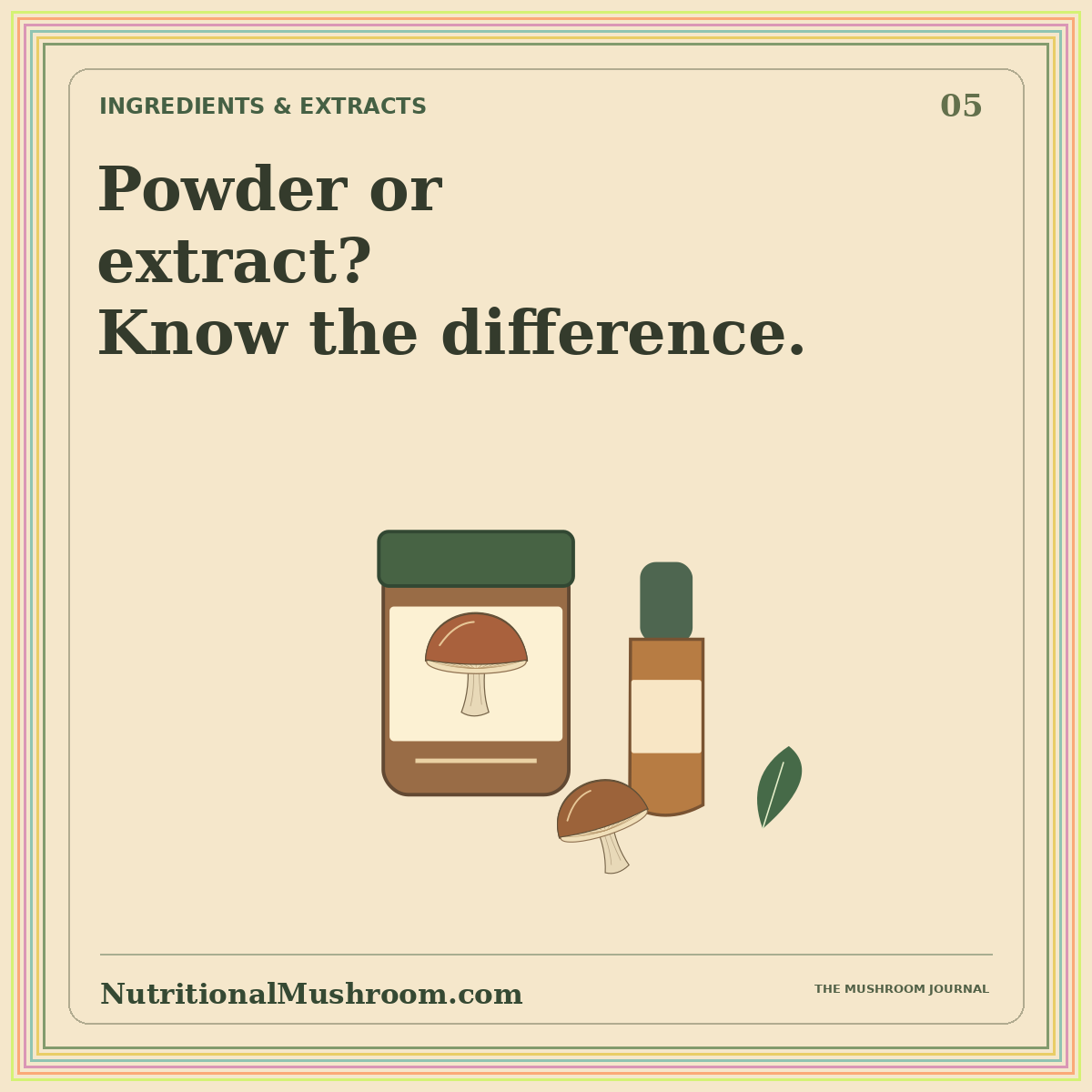
“Mushroom powder” and “mushroom extract” sound like two straightforward categories, but product labels do not always use them in a way that makes comparison easy. An extract can be dried into a powder. A culinary powder can be made by grinding dried mushrooms. A blend can contain both, along with ingredients that are not mushrooms at all.
The useful starting question is therefore not which word sounds stronger. It is what material was used, what happened to it during processing, and what the finished product actually contains. This guide explains a comparison method without recommending a product, a dose, or a claimed health outcome.
Powder describes a physical form
A powder is a material in fine particles. In food use, a product described as whole-mushroom powder may be made from dried, ground mushroom material. But the word powder alone does not establish that the product is whole mushroom, which species it contains, or whether it is intended for cooking. Those details need to come from the ingredient statement and product description.
This becomes important when comparing a bag of culinary seasoning with a supplement jar. Both may look like a fine brown powder while differing substantially in composition and intended use. A photograph cannot resolve that difference. Read whether the manufacturer describes grinding, extraction, blending, or another process, and keep unanswered questions separate from confirmed details.
Extract describes a preparation process
Extraction involves separating selected constituents from a starting material using a process that may include a solvent such as water or alcohol. The NIH Office of Dietary Supplements explains this general preparation vocabulary in its botanical background fact sheet. Mushrooms are fungi, not plants; the reference is useful here for the meaning of extraction terms, not for proving mushroom-specific benefits.
An extract may be sold as a liquid or processed further into a dry ingredient. This is why “powder versus extract” can be an incomplete contrast. The more precise comparison is often ground whole material versus a specified extracted preparation. If the packaging does not clarify which applies, ask the manufacturer before assigning it to either category.
Start with the full ingredient statement
Record the mushroom name, the part or material used, and any additional ingredients. Look for whether the label describes a fruiting body, mycelium, or a blend. Also identify carriers, flavorings, and other ingredients in the finished product. The headline on the front may emphasize only one part of that composition.
Do not assume an unlabeled detail is favorable or unfavorable. For example, a product that says “mushroom blend” without individual amounts leaves a comparison unresolved. It does not justify guessing equal proportions. A disciplined label review is comfortable with incomplete information and does not turn a missing answer into a confident conclusion.
Treat extraction methods as descriptions
Labels may mention hot-water, alcohol, or dual extraction. Those terms can describe processing, but they are not automatically rankings of clinical value. The meaningful question is what the process produced and whether evidence about that specific preparation is relevant to the intended use. A longer process name does not establish a larger benefit.
When reading a manufacturer's explanation, distinguish a description of how the ingredient is made from a claim about what it does in people. These are separate statements requiring different support. A production method can be accurately described while an advertised health outcome remains uncertain. You do not need to accept or reject both statements as a package.
Do not confuse a ratio with an outcome
A label such as “8:1” may be intended to describe a relationship between starting material and extract, but you need the manufacturer's definition to interpret it. Ask whether the numbers refer to dry starting material, the extracted ingredient before blending, or another basis. Without that context, comparing two ratios can give a false sense of precision.
Even a clearly defined ratio is not a direct measure of how a person will respond. Different starting materials and processes can yield different compositions. Nor does a ratio automatically specify an amount of any particular constituent. Treat it as one technical detail to clarify, not as a universal multiplier for effectiveness or a basis for self-selected dosing.
A better comparison worksheet
Imagine two hypothetical jars. One lists a single mushroom ingredient and clearly describes dried, ground food material. The other lists a mushroom extract, a carrier, and a flavoring, but leaves the extraction ratio undefined. Write those facts in separate rows rather than trying to reduce them to one “strength” number.
Your next question for the first jar might concern food preparation instructions. For the second, it might concern the extract description and the amount of each finished ingredient. The products could serve different purposes, so a head-to-head winner may not be a useful result. Sometimes the best finding is that they are not comparable for your intended use.
Understand what a composition claim can tell you
A claim about a measured constituent needs a clear analyte, unit, method, and product basis. Ask whether the figure applies to the finished serving or only one ingredient before blending. Ask whether documentation matches the batch being sold. These questions help turn a vague claim into information that can actually be assessed.
Composition is still not the same as effectiveness. Knowing that a product contains a measured substance does not, by itself, establish that it improves a particular health outcome. Our supplement label guide places quality, composition, safety, and evidence in separate parts of the decision so a good answer in one category does not silently answer all the others.
Match the form to its stated purpose
For cooking, choose a product clearly sold for culinary use and follow its food-use instructions. A mushroom seasoning can be useful when you want a mushroom flavor without fresh pieces in the dish. Check for salt and other seasonings before adding it to an already seasoned recipe. Do not substitute a supplement scoop for a culinary measure by assumption.
For a supplement, the question changes from recipe convenience to an individualized health decision. A capsule, powder, or liquid is simply a delivery form; none removes the need to examine the complete product and discuss personal risks. “Easy to stir into coffee” is not evidence that the product is appropriate for everyone who drinks coffee.
Compare cost only after comparing contents
A cost-per-gram figure can be misleading when the grams describe different materials. A whole food powder and an extracted blend may not have the same composition or purpose. The lower price for an equal jar weight does not settle value, and the higher price does not demonstrate greater effectiveness.
Use cost as a final practical consideration once you understand what is being compared. Include the amount you are likely to use according to its intended purpose and the information available about the product. If critical details remain unclear, postponing the purchase can be more useful than building an elaborate spreadsheet around assumptions.
Keep safety separate from marketing language
Do not take the word concentrated as a reason to improvise a serving, combine several extracts, or replace prescribed treatment. Discuss supplement use with a clinician or pharmacist, particularly when medicines, health conditions, pregnancy, breastfeeding, childhood use, or procedures are involved. A familiar food name does not guarantee that every preparation has the same safety profile.
This article also does not provide a home-extraction method. Making an uncontrolled preparation is a different activity from choosing a food ingredient or reading a commercial label. The extracts hub stays focused on terminology, documentation, and the limits of claims rather than recipes for concentrated products.
The takeaway
Powder describes a form; extract describes processing; neither is a complete quality or health statement. Identify the material, process, ingredients, and intended use before comparing numbers. Keep missing information visible, avoid converting ratios into promises, and make food decisions and supplement decisions with the different questions each requires.
Source and further reading
The general extraction vocabulary is explained in the NIH Office of Dietary Supplements botanical background fact sheet. That reference describes preparation concepts and their limitations; it is not proof that a mushroom extract has a particular medical effect.